
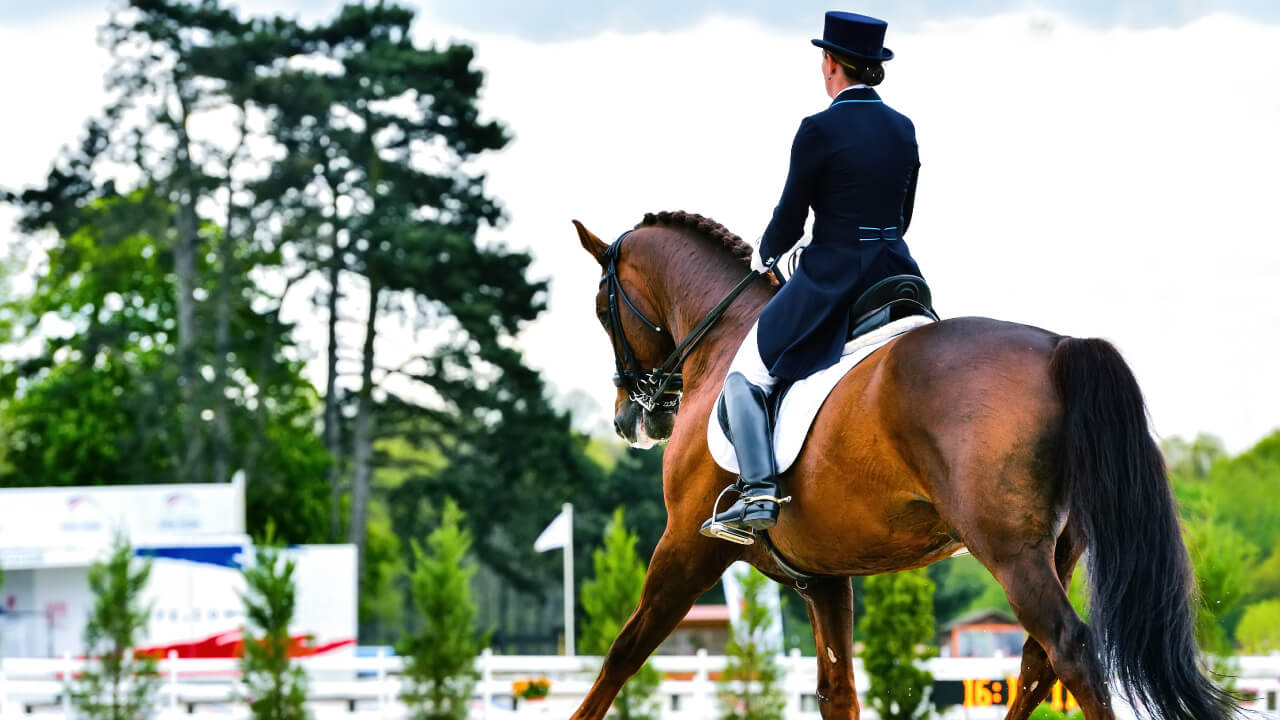
The Paralympic Games have finally begun.
In this article, we introduce the selection process, members, and horses of Japan’s Paralympic equestrian team for Tokyo 2020. By reading this, you’ll enjoy Paralympic equestrian events even more.
Whether you’re unfamiliar with Paralympic equestrian sports or just curious, we hope you’ll read to the end and develop an interest in this exciting sport.
Overview of Tokyo 2020 Paralympic Equestrian
| Event Schedule | July 23 (Fri) – August 7 (Sat) |
| Venue | Equestrian Park |
| Events | Para Dressage (Team & Individual), Freestyle |
| Japanese Athletes | Sho Inaba, Katsuji Takashima, Mitsuhide Miyaji, Soji Yoshigoe |
Features of Paralympic Equestrian
Presence of ‘Cuer’ and ‘Captain’
Paralympic equestrian sports are classified into Grades I to V, with lower numbers indicating more severe disabilities. One key difference from Olympic equestrian is the presence of ‘cuers’ and ‘captains’ who support riders with disabilities. ‘Cuer’ guides the horse with voice commands, while ‘Captain’ provides course and position guidance from outside the arena.
Only ‘Dressage’
Unlike Olympic eventing that includes jumping obstacles, Paralympic equestrian exclusively features dressage, where judges score on precision and artistry. Competitors are divided by their grades, competing within their categories.
Innovations in Horse Gear
Riders with various disabilities participate, so adaptive equipment modifications are permitted to ensure fairness. Riders unable to hold reins operate via mouth, neck, or full-arm control, showcasing ingenuity in gear design. Noting these advances is one of the highlights of the sport.
Selection Process for Tokyo 2020 Paralympic Equestrian Athletes
Japan has four host nation quotas. Selection is based on results from competitions held between March 2019 and June 15, 2021, with at least two international federation-sanctioned events. Top performers based on overall points ranking are eligible. The Japan Equestrian Federation officially confirms team members at their June 2021 board meeting. Four athletes listed below were selected for Tokyo.
Tokyo 2020 Paralympic National Team Members
Here we detail the team members and their horses.
Sho Inaba
Sho Inaba, born with cerebral palsy, has impaired legs. His horse is ‘Casanova,’ paired since 2019.
The 25-year-old is Japan’s top hope. Due to weak leg strength, controlling the horse is challenging. He competes in Grade III. Having started riding in elementary school for rehab, he trained since 2017, based at a riding club in Shizuoka. Remarkably, he competed at the 2018 World Championships just a year after starting serious training, earning his spot in Tokyo.
Katsuji Takashima
Katsuji Takashima has right-sided paralysis. His horse is Kennedy.
After middle school, he aimed for a career in horse racing, entered jockey training, and debuted as a jockey in 2011. He competed in Grade IV. He was active in JRA until a fall in 2013 ended his racing career. He shifted to Paralympic dressage, accumulating experience including the 2018 World Championships. He’s now preparing for his first Paralympic appearance. His horse, Kennedy, born in Germany, is 11 years old. Under the guidance of former Olympic team coach Shunichi Terui, he trains at a prestigious club.
Mitsuhiro Miyaji
Veteran Miyaji, 63, competed in Rio 2016. He fell ill with a stroke at 47, leaving him with severe paralysis. Diagnosed with cognitive impairments, he turned to Paralympic dressage for rehab and has competed as Japan’s representative in two Games. His wife Yumiko supports his performances, and they practice together aiming for high placements.
Soji Yoshigoe
Yoshigoe is a current university student and a rising star in Japan’s Paralympic equestrian scene. He has cerebral palsy and competes in Grade II. Since middle school, he’s trained toward Paralympic participation, finally realizing his dream. His strong bond with his horse, Excellent, is evident on Twitter.
Just now!
Since it was rainy, I rode Excellent carefully after a long time!!Thanks for more practice, everyone! 🦽🏻
#AsureHorseClub #HorseRiding #Dressage #DressageCompetition #EquestrianSports #Paralympics #Paralympics #Tokyo2020 #Tokyo2020
Due to the limited clubs accepting athletes with disabilities, initially, it was challenging to find practice venues. However, under the guidance of Shinmasa Asakawa, who participated in London 2012, at the Shizuoka Riding Club, rigorous training was possible.
Yoshigoe emphasizes that Tokyo Paralympics is just a stepping stone. With more experience, he’s expected to achieve great results in the future.
Summary
Paralympic equestrian involves mixed-gender dressage where humans and horses form a team. Its greatest appeal is that it’s the only sport where people and animals work together, showcasing harmony.
It highlights not only physical abilities but also communication with horses and adaptive techniques that break gender and age barriers, making it an inclusive sport enjoyed by many.
Four athletes are representing Japan at Tokyo 2020. We encourage everyone to enjoy Paralympic equestrian during this global sporting event happening once every four years!