
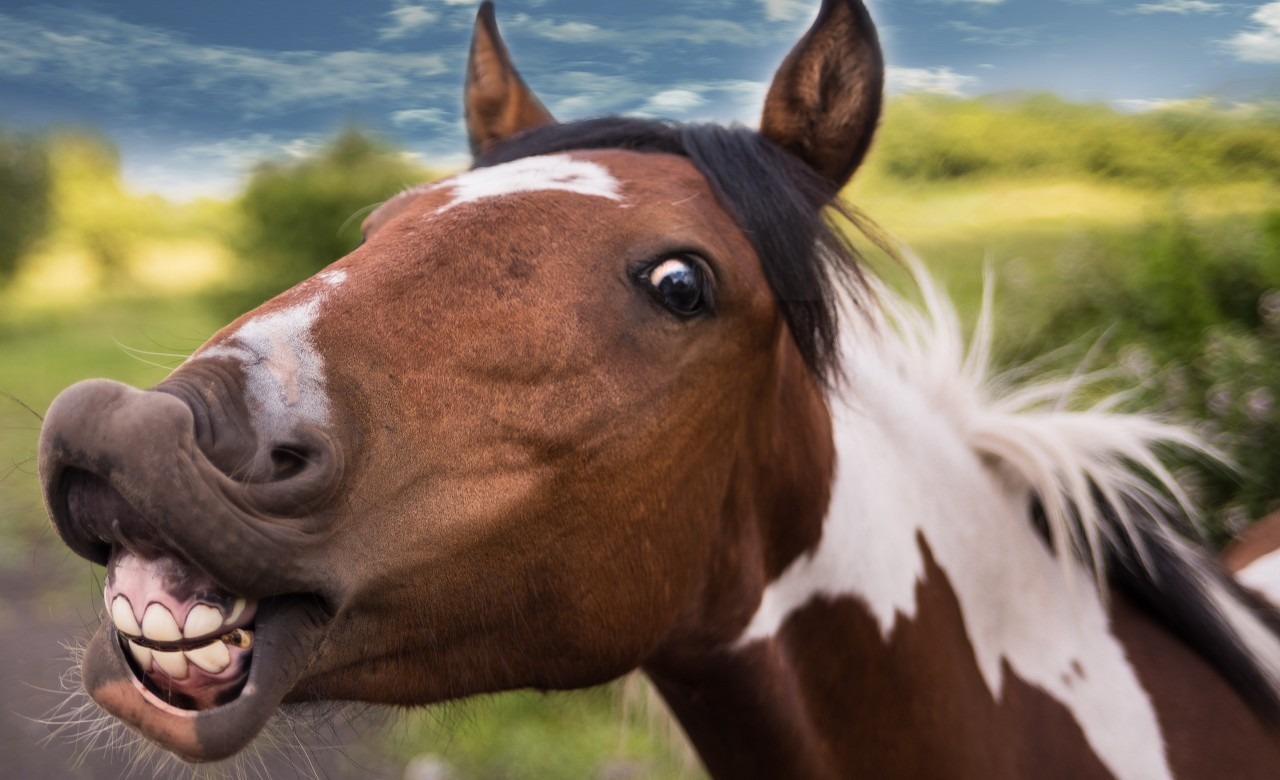
Herbivores are said to have a significantly wider field of view compared to humans and carnivores. In the first half of this article, we will answer questions such as how much range horses can actually see and whether there’s a connection to their horizontally elongated pupils. The second half will include tips on how to approach horses without scaring them, so please read on.
Key Point: Position of the Horse’s Eyes

Comparing the position of a horse’s eyes to ours, horses’ eyes are attached almost side-by-side on their faces. In contrast, humans have eyes facing forward. This difference is believed to be due to their different lifestyles as wild animals.
Our ancestors and monkeys relied on tree-dwelling lifestyles, requiring precise depth perception to navigate tangled branches. When humans began hunting, distance awareness also became important.
To judge this distance, animals need to see what both eyes observe as overlapping. Therefore, animals that see in stereo tend to have faces with eyes positioned close to the front, with overlapping visual fields.
However, many herbivores, including horses, need to escape predators, so they benefit more from a wide visual range than stereoscopic vision. This led to their eyes being positioned on the sides of their faces.
Pets like dogs and cats—carnivores—have forward-facing eyes, but in nature, many animals have eyes on the sides.
Horizontal Pupils for Wide Field of View

When looking at a horse’s eyes in bright light, you can clearly see that the pupils are elongated horizontally. While pupil shapes vary among animals, why are a horse’s pupils so horizontally elongated?
The exact reason isn’t clear, but one theory suggests it’s to maintain a wide field of view even when the pupils constrict in bright light. Unlike humans with round pupils, which narrow equally in bright conditions, horses’ pupils narrow vertically, keeping the width almost unchanged. Similar to how cat pupils narrow from side to side while maintaining vertical height, the shape of the pupil influences visibility and perception.
Horses, as well as cattle, goats, sheep, and deer, have these horizontal pupils. Interestingly, even whales—distant relatives of these animals—also have elongated pupils. This makes us curious about the pupil shapes of other animals, doesn’t it?
360-Degree Field of View

From the previous discussion, it’s clear that horses’ eyes have evolved to prioritize a wide visual field. How wide is a horse’s actual field of view (the range they see while looking straight ahead)?
Human’s visual field is approximately 200°, but a horse’s field of view is around 350°. This means horses can see nearly everything except their tail area. Considering humans can turn their heads 60–70° to each side to observe, horses can see within their natural head position over a similar range.
Furthermore, if they turn their head slightly, they can see directly behind them. However, just like humans are surprised if suddenly tapped on the shoulder from the side’s edge of their visual field, horses will also be startled if approached from behind the limit of their field of view, beyond their ‘hip angles.’
Horses react defensively when frightened, sometimes kicking, which can be dangerous. To keep horses calm and avoid injury, approach them carefully and without startling them.
How to Approach Horses Without Spooking Them

What should you pay attention to when approaching a horse? Let’s review three important points.
Approach from the Front Where They Can See Well
First, as discussed earlier, even though horses have a wide field of view, the rear is a blind spot. Also, the edges of their visual field are less clear than the center. Avoid approaching from these less visible areas.
Always approach “from the front where the horse can see clearly.” Although it’s common to stand on the horse’s left side when caring for him or leading him, approaching from the right side is also fine, but approaching from the front-left is preferable for clarity.
In cases where you need to stand near the horse’s hind legs or directly behind, approach from the front and touch the horse gently, making it clear that ‘it’s me who approached from the front’ so the horse recognizes you.
Approach Slowly
Horses are very cautious of sudden movements within their visual range. For example, rushing towards them or waving your hands vigorously can startle them, causing them to step back or flatten their ears, showing discomfort. Running at them is particularly alarming due to both motion and noise.
Approaching slowly from the front and giving the horse time to recognize you, maybe by letting them smell you, helps prevent surprises. Horses are known to remember people they see often, partly through their sense of smell and facial recognition.
Speak Calmly
The third key point is to speak softly. Horses have excellent hearing as well as vision, and they respond sharply to sounds. Speaking softly while approaching lets the horse understand you are coming peacefully.
You don’t need a specific phrase, but many people call the horse by its name. Speaking calmly in a low voice can help calm a nervous horse, similar to soothing them when they are agitated.
In contrast, raising your voice suddenly or speaking loudly can scare the horse, making it feel threatened. Even if you’re happy to see your horse after a week, remain calm to avoid being perceived as a threat.
Summary
Herbivores, including horses, have evolved to have a wide field of view crucial for survival in the natural world. Its width is said to be about 350°, with almost only the tail area outside their view. However, this broad range also makes them more sensitive to visual stimuli, causing them to startle easily. Their blind spots are mainly behind the hips, and approaching from there can be unsettling. When approaching a horse, do so from an angle where they can see well, speak softly, and approach slowly. Doing this keeps the horse calm and prevents accidents.