
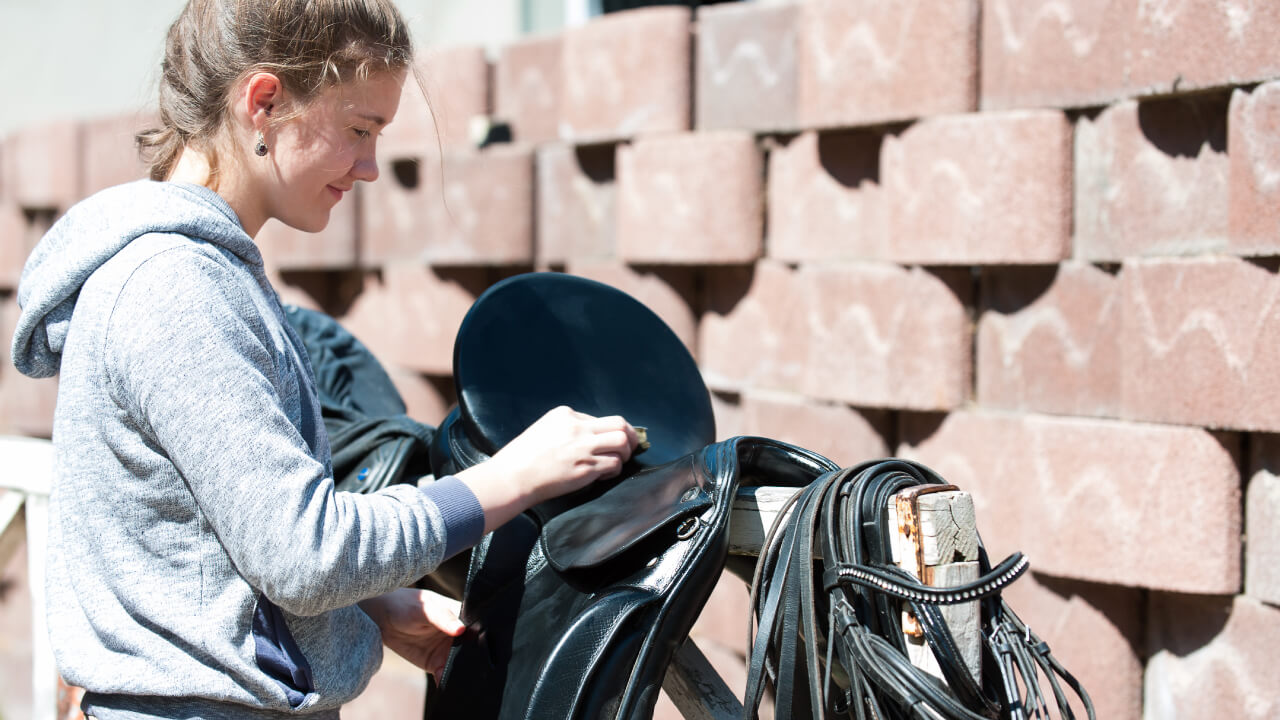
Essential equipment for riding horses includes bridles and saddles. When first seeing horse tack, you might wonder, “Why are there so many parts?” In this article, we’ll explain the necessity of bridles and saddles, including the names of each part.
What is a Bridle? Introduction to Parts
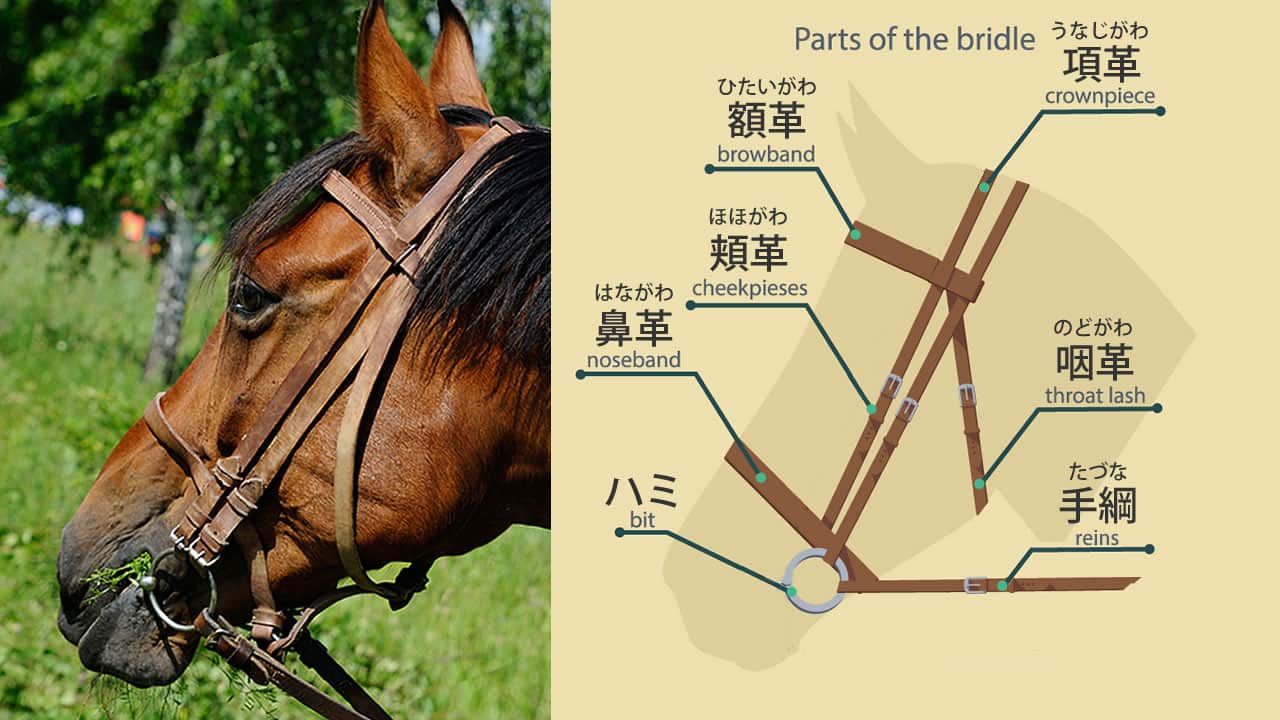
Bridle (とうらく) is horse tack worn on the head of a horse. The reins, which are crucial for giving commands, are also part of this bridle. For beginners, properly fitting a bridle can be challenging at first. Understanding the structure of the bridle is essential for proper horse care and riding gear maintenance.
Throat latch, cheek pieces, and noseband
Throat latch (u-naji gawa) passes behind the horse’s ears and is connected with cheek pieces (ho-ga gawa) and noseband (no-ga wa).Cheek pieces connect to the bit, helping to keep its position steady. The noseband prevents the bridle from slipping forward.
Forehead band
Forehead band (hitaiga wa) passes over the horse’s forehead and can be decorated with Swarovski crystals or embroidery. When fitted, it appears as if the horse’s ears protrude between the throat latch and forehead band, helping prevent the bridle from slipping backward.
Noseband
Noseband (hana gawa) is positioned slightly behind the corners of the mouth and intersects at right angles with the cheek pieces. When a horse opens its mouth widely, it can destabilize the bit. The noseband wraps around the bridge of the nose to the chin.
Bit and reins
The horse’s teeth include incisors and molars, with a gap called interdental space where the bit fits. The bit transmits rider’s commands via the reins, which are pulled to apply pressure on the horse’s mouth.
What is a Saddle? Parts and Components
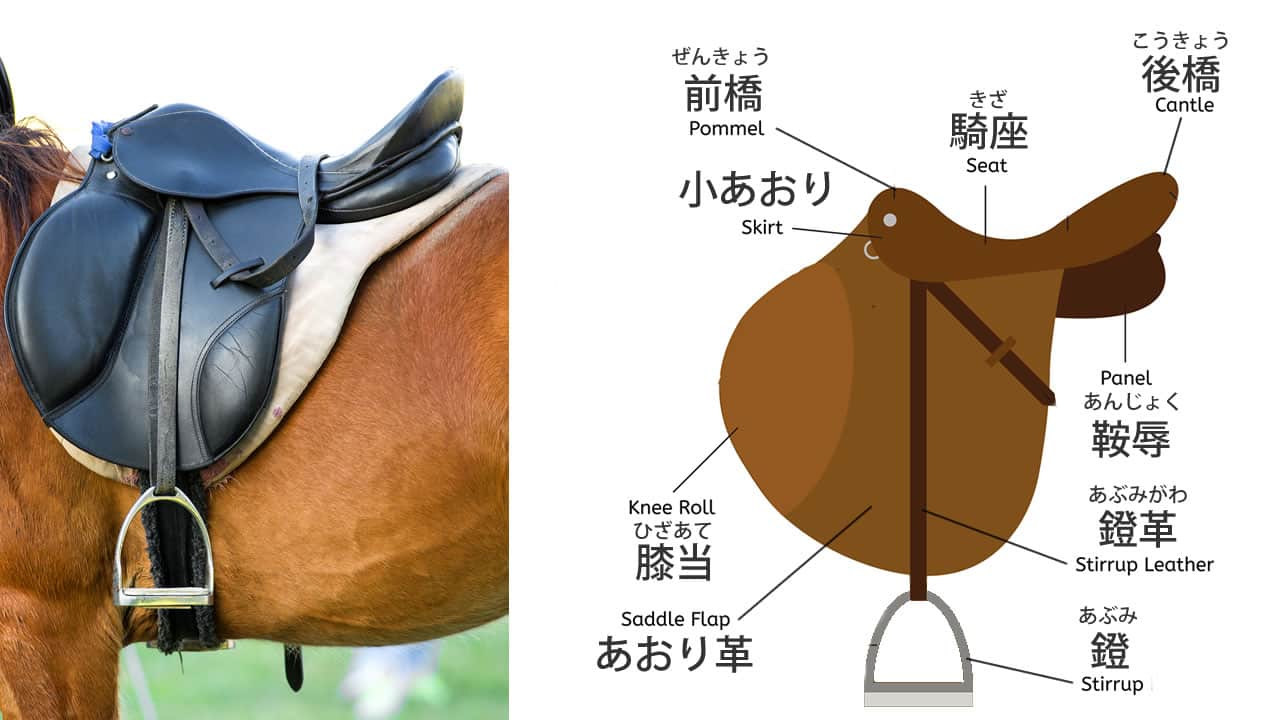
Saddle (kura) is harness placed on the horse’s back. It has many parts, and it may take some time to memorize the names and learn how to attach it correctly. Proper understanding of the saddle is crucial for riding stability and safety.
Riding seat, front arch, rear arch
The riding seat (kiza) is where the rider sits. The front and rear arches (zenkyo and ko-kyo) create raised areas that help keep the rider in position without shifting forward or backward.
Saddle pad
The saddle pad (sankon) beneath the saddle helps stabilize and protects the horse’s back. The proper position of the saddle and saddle pad is essential for rider comfort and safety.
Saddle flaps, stirrups, and stirrup leathers
The saddle flaps extend down from the saddle to protect the rider’s legs and help secure their position. The stirrups are used to support the rider’s feet, with their length adjusted using the stirrup leathers.
Types of Saddles
There are different saddles suited for various disciplines and purposes:
Jumping saddles
Designed for forward-leaning riding positions that stabilize the rider during jumps. Features include raised cantles and larger knee rolls.
Dressage saddles
Allow for a deep, balanced seat for precise control. The flaps are longer and flatter for closer contact.
All-purpose saddles
Hybrid models suitable for multiple disciplines, commonly used in riding clubs.
Racing saddles
Smaller and lighter, optimizing speed and agility. The design reduces weight and maximizes mobility.
Western saddles
Features a prominent horn at the front, and often used in Western riding styles. The saddle is usually heavier and more rugged.
Summary
Bridles and saddles are essential horse riding gear that not only ensure rider safety but also reduce the burden on the horse. Understanding their basic structure and functions will enable smoother tack fitting and riding experiences.