
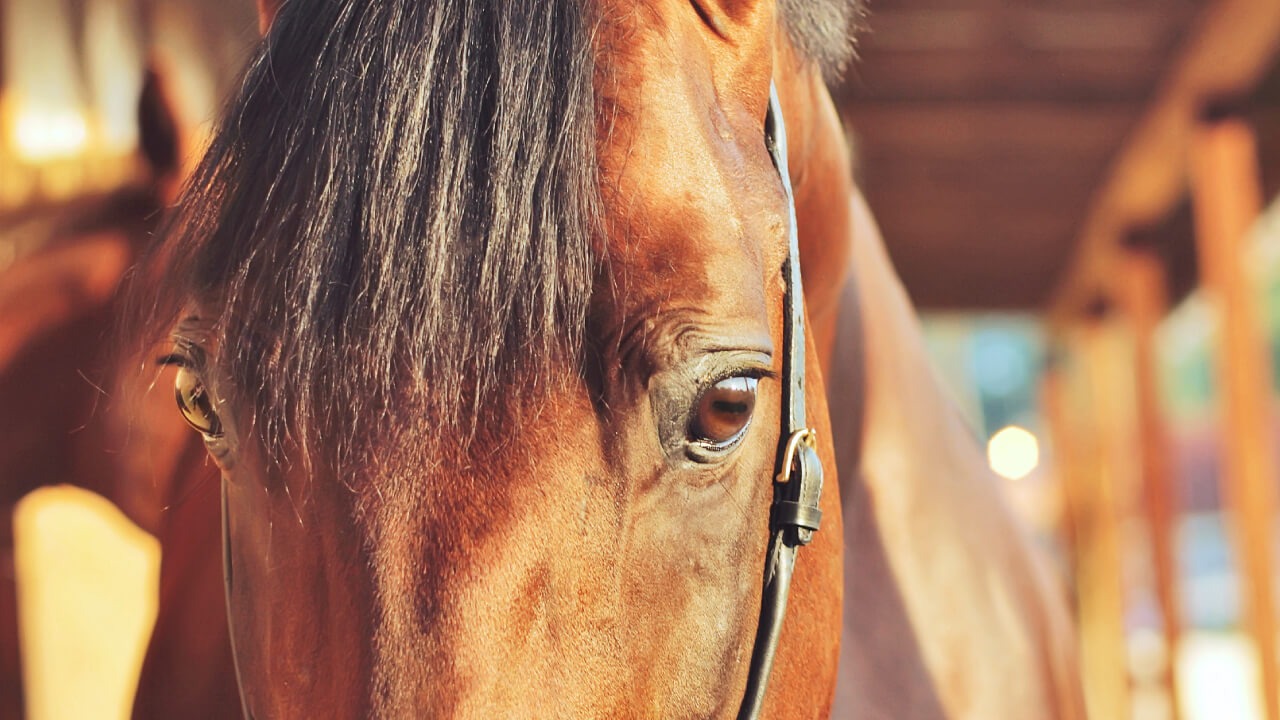
Many people may know that herbivores have wide fields of view, but how much can a horse see when facing forward? In this article, we explore the horse’s field of vision, how they perceive colors, and the secret behind their night vision.
Range of a Horse’s Field of View
Can They See Behind Them?
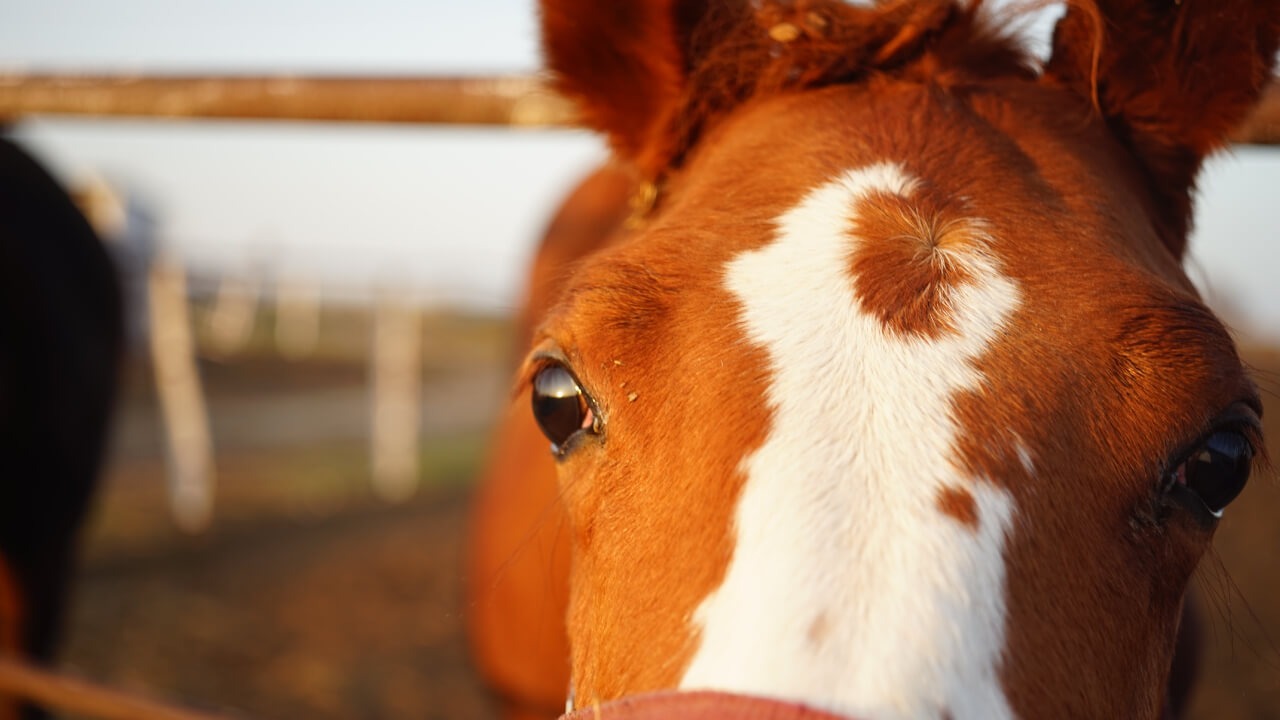
It is commonly said that herbivores have a wider visual field than carnivores, enabling them to spot predators early and escape quickly. Horses, in particular, have an astonishing visual span of about 350°.
Since human vision covers about 200°, horses’ wide field of view is impressive in comparison. Imagine it like a panoramic photo of the landscape.
When you see something at the edge of your vision, you naturally turn your head to check it out. Horses do the same, and their most detailed vision is at the front, with the edges being a critical zone where visibility fades.
The critical zone when a horse faces forward is roughly at waist height. Behind that, they may feel like someone is standing right behind them. This explains why touching a horse’s rear unexpectedly or standing directly behind it can be dangerous.
Despite their size, horses are naturally cautious animals. If they feel uneasy, they may become anxious if someone stands in their blind spot. Approaching from an angle that stays within their clear sight is best, and talking softly while moving behind them helps too.
Tools That Narrow the Vision
The broad visual range is an evolutionary trait that helps horses protect themselves. However, when horses become working animals or partners, their environment might require modifying their vision.
Devices like racing blinkers and cart horse blinkers are used to block the rear view, helping horses focus on front tasks.
While horses have wide lateral vision, their vertical field of view is less well-documented. Wild horses are rarely attacked from above, and their eyeballs are horizontally elongated, suggesting narrower upward vision.
On the other hand, since their eyes are positioned toward the sides of their noses and they can be afraid of ground shadows, their downward view is probably comparable to or even wider than humans’.
Some horses wear “shadow rolls,” a foam nose piece that also helps with downward vision sensitivities. This is familiar to riders as part of headgear or blinkers, and can look quite adorable.
Can Horses See Colors?

Horses See in “Dichromatic” Colors
Next, let’s explore how horses perceive colors. There’s no precise way to determine their color vision, but studies of their eye cells and reactions suggest they see the world differently than humans do.
It’s believed that horses, like many mammals, have only two types of cone cells, meaning they perceive colors through a process called dichromatic vision. Humans, with three types of cone cells, see the world with full trichromatic color vision.
Because horses probably don’t perceive red well, their color perception is likely limited. To illustrate, the following images compare typical human color vision with how horses might see.
The left image shows normal trichromatic vision, while the right simulates vision without red, resembling dichromatic perception.
This comparison hints that horses might see the world in shades of blue and green, with limited or no perception of red.
Interestingly, this means that certain colors visible to humans may be less noticeable or even confusing to horses—like how bright red flags or markers can be less visible, while greens and oranges may appear similar.
Riders and course designers are increasingly considering horses’ color vision, and some venues are creating environments that are safer and less stressful for them, which can help prevent accidents.
Can Horses See in the Dark?
Have you ever visited a dark stable or ridden in the early morning? If so, you might have noticed that horses can see quite well even in darkness.
Horses don’t sleep deeply at night and instead alternate short periods of sleep and wakefulness—a trait inherited from their wild ancestors, who needed to be alert for predators at all times.
In the dark, horses rely on a special part of their eyes called the tapetum. This layer reflects light back through the retina, amplifying the small amounts of light that enter and allowing horses to see in low light conditions.
When people take photos of horses with flash in darkness, their eyes often appear to glow—this is a reflection from the tapetum. Horses are very sensitive to light and should never be flashed during photos to avoid stressing them.
Summary
Horses have a much wider field of vision than humans and can see quite well even in darkness. While this is a great advantage, it can sometimes make horses startled by things humans can’t see. Their color vision is more limited than ours, and they perceive the world with fewer colors. Many of their behaviors and reactions that puzzled us may actually be due to differences in visual perception.