
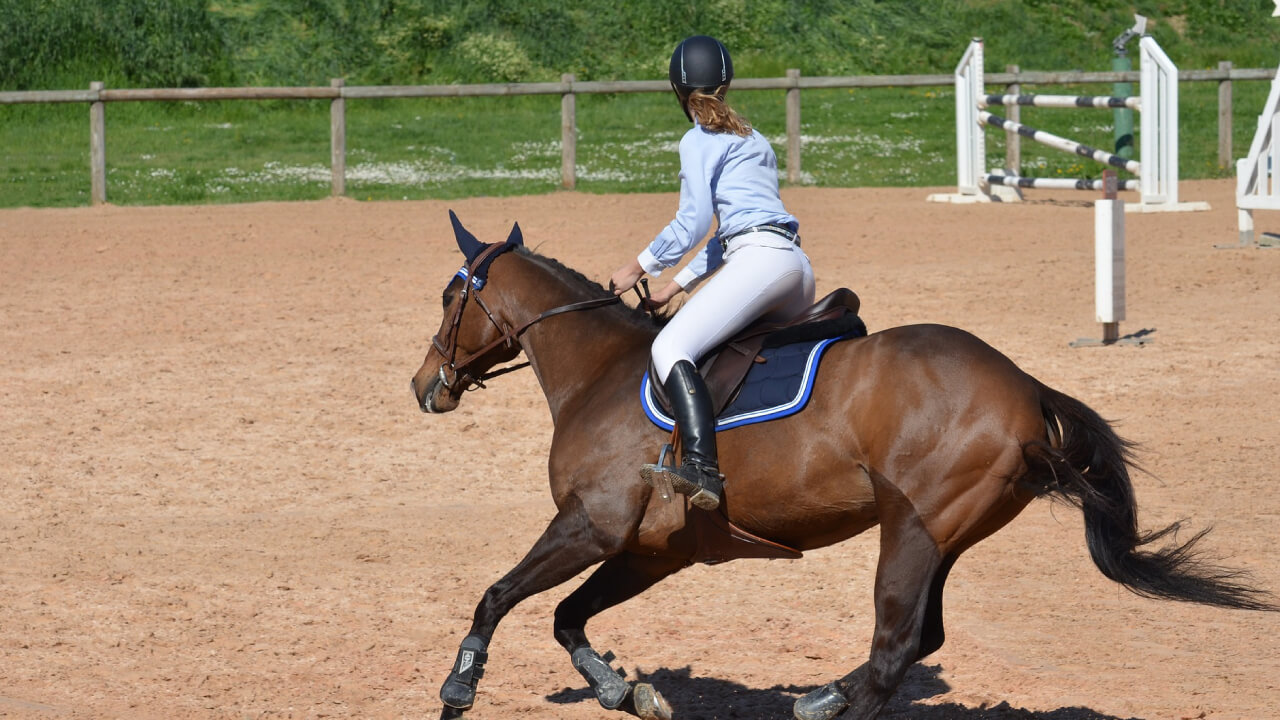
Compared to a walk, posting trot and canter are a little more challenging. Especially for beginners, you might find yourself thinking ‘I finally got the canter, but I can’t keep it going…’ In this article, we’ll explain common mistakes beginners make that cause them to lose the canter and how to improve.
Pulling the reins immediately after the canter begins

If you immediately decelerate after the canter starts, it might be because you’re unknowingly pulling the reins too much. Let’s look into why pulling on the reins is problematic and what to do instead.
Confusing the horse
When the canter begins, the horse suddenly moves forward aggressively. From the rider’s perspective, it’s like a car suddenly accelerating, giving a feeling of being pulled backward. At this moment, are you gripping or pulling on the reins to maintain your balance?
Remember, pulling the reins means slowing down or stopping. So, when you give the cue to start the canter, but the horse follows this with stopping immediately, it creates a conflicting signal. Naturally, this causes the horse to slow down or halt.
To keep your posture without relying heavily on the reins, it’s important to anticipate the rebound when initiating the canter. Once you understand when and how strongly the horse reacts, you can practice adjusting your weight and posture to stay with the horse’s movements.
Do not pull or tighten the reins
First, it’s crucial to avoid unintentionally pulling or tightening the reins, which can interfere with the horse’s movement. Conversely, leaving the reins too slack is also problematic because the horse may ignore your signals entirely.
Keep the reins gently taut—never slack. With some practice, maintaining a light tension allows you to make subtle adjustments easily, transmitting clearer signals to the horse.
Insufficient cues to the horse

Moving on from the reins, let’s discuss aids with the legs. Compared to walk or trot, aids for the canter are slightly more complex. Here are some key points and cautions to keep in mind.
Starting cues
First, let’s review the signals for starting the canter. Many riding schools teach to move the outside leg back while bringing both legs in. Think about what this movement signals to the horse.
The leg pulled back indicates, “Push off from this leg.” When observing the start of the canter, the hind leg on the outside moves first, then the inside hind, outside front, and inside front. By specifying which leg to move first, you ensure the correct lead for the canter.
The other leg usually presses against the horse’s side, signaling “Go forward” along with “Maintain the inside bend.” When performing a circle or a turn, this helps the horse bend around the inside, forming an arc—known as the “inside bend.”
Properly communicating which leg to use first and which lead to take helps initiate the correct canter from the start, reducing mistakes like slowing down to correct the stride.
Beware of slowing down
Even once the canter is established, pulling on the reins or trying to adjust the lead can cause the horse to slow down. If aids are not used consciously, the horse will naturally tend to lose speed.
Many beginners notice the horse slows down during the transition from trot or walk and only realize it afterward, but it’s best to anticipate slowing down before it happens. Applying leg aids early can help maintain the canter effectively.
Leaning forward and shifting weight onto the front legs

When aids are correct but the canter doesn’t continue well, consider your posture. Leaning forward too much might be the cause of failure.
Forward tilt makes it hard for the horse to run
Like humans, horses have stronger muscles in their hind legs than their front legs, which support their weight. If your weight shifts forward, it becomes difficult for the horse to maintain a smooth gait.
Try to sit with your chest up, imagining your shoulder blades slightly behind your sit bones. Relaxing is key, as tension can cause you to hunch forward, so focus on staying relaxed from the start.
Backward shift and propulsion
In sprinting, many have seen the blocks supporting the runners’ heels. A similar principle applies: supporting from behind can help push the animal forward with more power.
When the horse’s weight is gathered on the hind legs, it can extend its front legs more freely, generating greater propulsion. Effective push-off from behind makes maintaining a strong canter easier and less prone to slowing down. If you feel your canter is losing momentum, try to be mindful of your weight distribution and aids.
Bouncing on the saddle

The last point is to follow the horse’s movement closely. If your movement doesn’t match the horse’s, your body might bounce on the saddle, causing discomfort and the horse stopping the canter from feeling unnatural.
Follow the horse’s movement
This is called riding in formation or “zuihan.” When you move in harmony with the horse, it becomes easier and more comfortable for both of you. To do this, experience various movements and gradually learn how the horse’s back and saddle move. Anticipating different shocks and adjusting your posture accordingly allows you to reduce impact and stay with the horse’s rhythm.
Imagining pushing the saddle with your hips
If your body bounces on the saddle during the canter, you might think, “My hips are rising off the saddle,” but once you improve seated balance, try to push the saddle forward in rhythm with the horse using your hips. It’s a subtle movement, similar to leaning forward while sitting on a chair close to a table. This technique helps you communicate aids through not just your legs but also your weight transfer.
Summary
To keep a consistent and stable canter, you need to pay attention to multiple points: reins, posture, and weight distribution. While juggling many factors at once can be challenging, the key is to follow the horse’s movement without interfering. Mastering the canter will allow you to enjoy a smooth ride with your horse!