
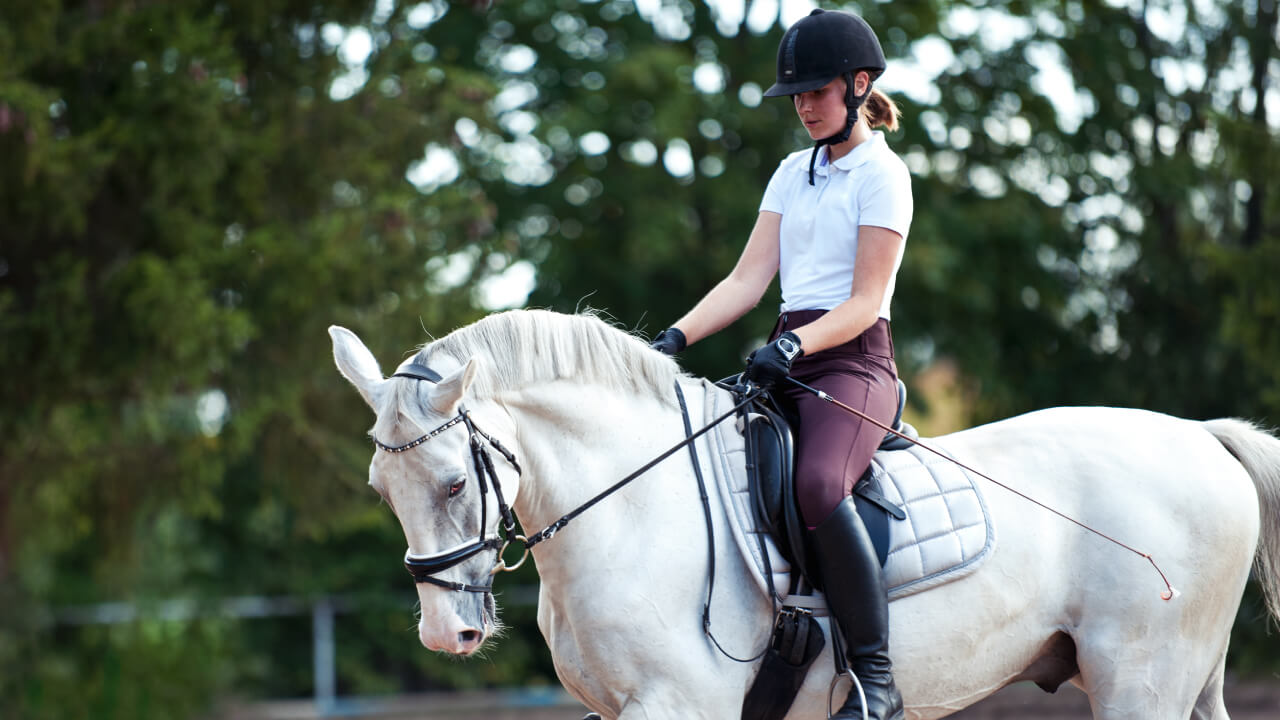
For beginners who are overwhelmed by balancing on horseback and giving instructions to the horse, adding a whip can be a challenging task. Since you need to hold both the reins and the whip, your hand might tighten more than usual.
Using a whip can improve the horse’s movement, which may cause some riders to feel uncertain about keeping up. Is a whip really necessary for beginners?
In this article, we will explain the types of whips, when and how to use them, and provide helpful tips for those who have never used a whip or are uncertain after being told to prepare one.
Types of Whips

Did you know that there are different types of whips? The type of whip used depends on where on the horse it is applied, the course being ridden, and other factors. In British riding, whips are categorized into ‘short whip,’ ‘long whip,’ and ‘overcheck’.
‘Short whip’ is, as the name suggests, a small whip. The typical length is about 50 to 70 cm, making it ideal for beginners. There are also affordable options that are easy for beginners to purchase. These come in various designs and colors, with some featuring adorable heart-shaped slips at the tip.
‘Long whip’ is a slender, extended whip. Most are around 100cm long, and the length is generally not less than that. For show jumping, long whips are not permitted in competitions. Beginners who are not yet accustomed to holding reins and long whips together may drop the whip accidentally, so it’s recommended to use ones with a loop to prevent falling. Many riding clubs start beginners with short whips and then progress to longer ones as they gain confidence.
‘Overcheck’ whips are over 160cm long, semi-strap-like whips. They are not used by riders during normal riding but are employed for training or exercises, such as connecting horses with lunging equipment or instructing horses that do not respond well during lessons.
When Are Whips Necessary?

Horse commands are primarily given through leg aids, but some horses respond poorly or not at all. Riders, especially beginners, may also have uncooperative guides using their legs.
If you can’t control the horse, riding becomes impossible. That’s where a whip is used.
The whip is used to encourage motion by tapping or stimulating the horse’s shoulders or hips, making them aware of the rider’s commands. However, it is not meant to hurt the horse; it’s a form of cueing.
Short whips are often used in show jumping and cross-country events and are permitted in competitions. Long whips are used in dressage but are not allowed in official competitions.
How to Use a Whip

The way of using short and long whips differs. Here, we introduce how to use them during riding.
Short whip
Hold the short whip with a long grip, snap your wrist, and use this motion to strike the shoulder with a loud ‘whack.’ Make sure to keep your arm steady while doing so to maximize the effect.
Just seeing the whip is often enough to have an effect on the horse, even without striking. Simply holding a whip can signal your authority.
Long whip
For the long whip, point the tip toward the horse’s hindquarters and hold it close to your thigh. Use your elbow slightly open and snap your wrist to gently touch and stimulate the horse’s skin and muscles.
Be careful not to apply too much force, as it can cause pain. Also, since the tip is on the opposite side of your riding direction, be mindful not to accidentally hit the horse’s hindquarters while the whip is in a resting position.
Precautions When Using a Whip

Here, we explain important points to keep in mind when using a whip.
Whips can energize a horse’s movement. Some horses may not react strongly, but others may react excessively. Start with a gentle approach and avoid startling horses that are sensitive to whips, especially at the beginning. It’s helpful to ask staff at the riding club for advice beforehand.
Also, using a tentative or half-hearted whip can confuse the horse, so be confident when using it. If you hesitate, the horse may become confused and not respond to commands, leading to more whip use and potential stress for the horse.
Summary
I hope you found this helpful.
Ideally, commands to the horse are communicated through rider’s leg aids, but when that’s not enough, a whip acts as a supplementary aid to improve communication.
When used correctly, these tools enhance riding, but misuse can cause discomfort or distress for the horse. Learning proper techniques and timing ensures safe and effective use.