During trot lessons, riders practice standing on the horse’s back while experiencing significant swaying. From an outsider’s perspective, everyone appears to effortlessly switch between standing and sitting, which might tempt beginners to try the same.
However, the swaying of the horse is more intense than it looks, making it difficult to maintain balance while standing. It’s a common challenge for first-time riders to feel how tough it can be.
So, what causes the difficulty in standing during trot? And what key points should riders focus on to balance while standing on a moving horse?
Here, we introduce tips and important points for standing during trot.
Reasons You Can’t Stand During Trot

Trot is a riding technique that minimizes the shocks from the horse’s back movement by absorbing the impacts directly. Even with correct riding posture, large shocks can prevent maintaining balance and cause the rider’s posture to collapse.
If you try to adjust your posture again, the continuous shocks while trotting make it difficult to recover unless the horse stops. This highlights how intense the impact is during trotting. Considering this, the main reasons for being unable to stand are often summarized as ‘technique’ and ‘timing.’
The moments when the horse’s movement is large suggest that the stirrups, hanging via a strap from the saddle, will sway with the impact. Although the toes are fixed on the stirrups and leg position is maintained, it’s impossible not to move at all.
During trot, you need to stand on these unstable stirrups. Mastering how to stand properly and firmly on the stirrups is essential.
Additionally, understanding the horse’s movement and timing your standing to coincide with the horse’s back lifting will help you absorb shocks. Standing at the wrong timing, such as when the horse jumps, results in continuous shocks, making riding unstable.
Thus, the inability to stand during trot mainly depends on ‘technique’ and ‘timing.’
Quick Tips on How to Stand Properly

Key points for standing during trot include ‘pressing the stirrups firmly,’ ‘holding the reins shorter,’ ‘bending the knees,’ and ‘not standing directly upright.’
When transitioning from sitting to standing, you need to shift your weight onto your legs to lift your hips. During trot, the same applies: you must firmly press your stirrups and put your weight on your legs. It doesn’t mean tensing excessively; you should keep the pressure on the stirrups consistently, whether standing or sitting.
Holding the reins shorter helps prevent your center of gravity from shifting backward, which could cause a backward fall. This adjustment helps keep your balance forward.
Bending your knees is crucial because, when standing, your body naturally balances by bending knees and shifting weight onto the toes of your stirrups. This posture facilitates lifting your hips.
Avoid standing straight up because the horse moves forward. Standing straight up would make you land toward the horse’s rear, disrupting your balance each time you sit down. Instead, try to ‘push your navel forward’ as you stand to maintain stability.
When is the Best Timing to Stand?

The trot is a two-beat gait. You stand when one leg hits the ground and sit when the other leg hits the ground.
To understand the movement of the horse’s legs, observe the horse’s feet and rhythm. It’s risky to look directly at the horse’s legs from a high position, as it could upset your riding posture or cause falling. A safer method is to check the movement of the horse’s front fetlock joint, which allows you to perceive the rhythm without risking your balance.
If you’re unsure which leg to coordinate your standing with, you can start by standing at the timing when you feel you can. However, generally, riders align their standing with the ‘outside’ leg.
This means, in a left turn, you stand when the outside right front hoof lands, and in a right turn, you stand when the outside left front hoof lands.
Key Points and Cautions for Mastery

Even with the tips introduced here, it might not be easy to succeed immediately. The swaying of the horse during trot is significant, and even if you understand it mentally, it takes practice to respond properly.
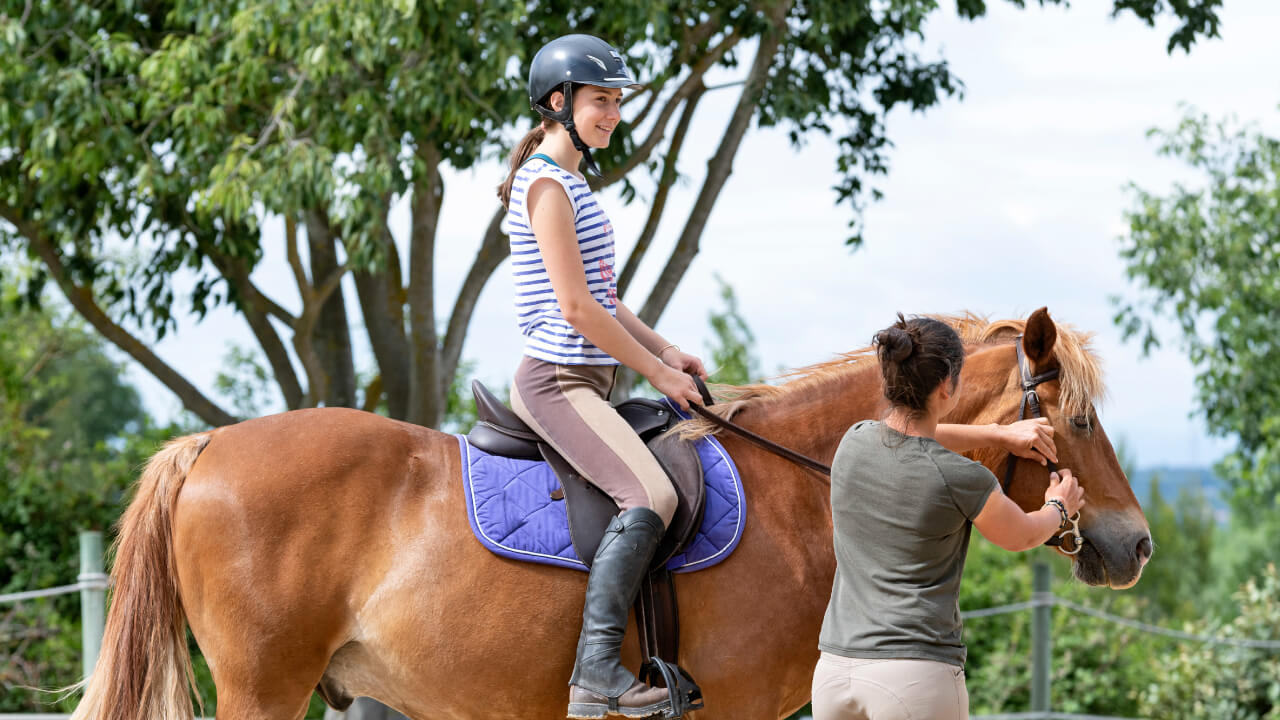
Start by practicing standing on a stationary horse, firmly pressing the stirrups and feeling the motion of standing up. For beginners, standing on an unstably swaying stirrup is challenging and can cause anxiety. It’s essential to understand where to place your weight and how much to bend your knees to stand comfortably.
Next, try syncing your movement with the horse’s leg motion by counting ‘1-2-1-2’ to establish rhythm. Before actually standing or sitting, take your cues from the horse’s rhythm and time your movements accordingly. This helps you anticipate the right moment, as the distance between movements is quite narrow.
Once you understand the rhythm and timing, practice standing and sitting smoothly. If you sit too long on the saddle, it might slow your response, so always keep in mind to stand up quickly and recover your balance.
Summary
In summary, mastering this technique allows you to avoid the shocks of trot in a graceful way. However, learning to stand during trot can be quite challenging for beginners. Important points include timing your movements with the horse’s rhythm and firmly pressing your stirrups.
Grasping these basics will greatly improve your riding skills over time, so persist and practice regularly.