
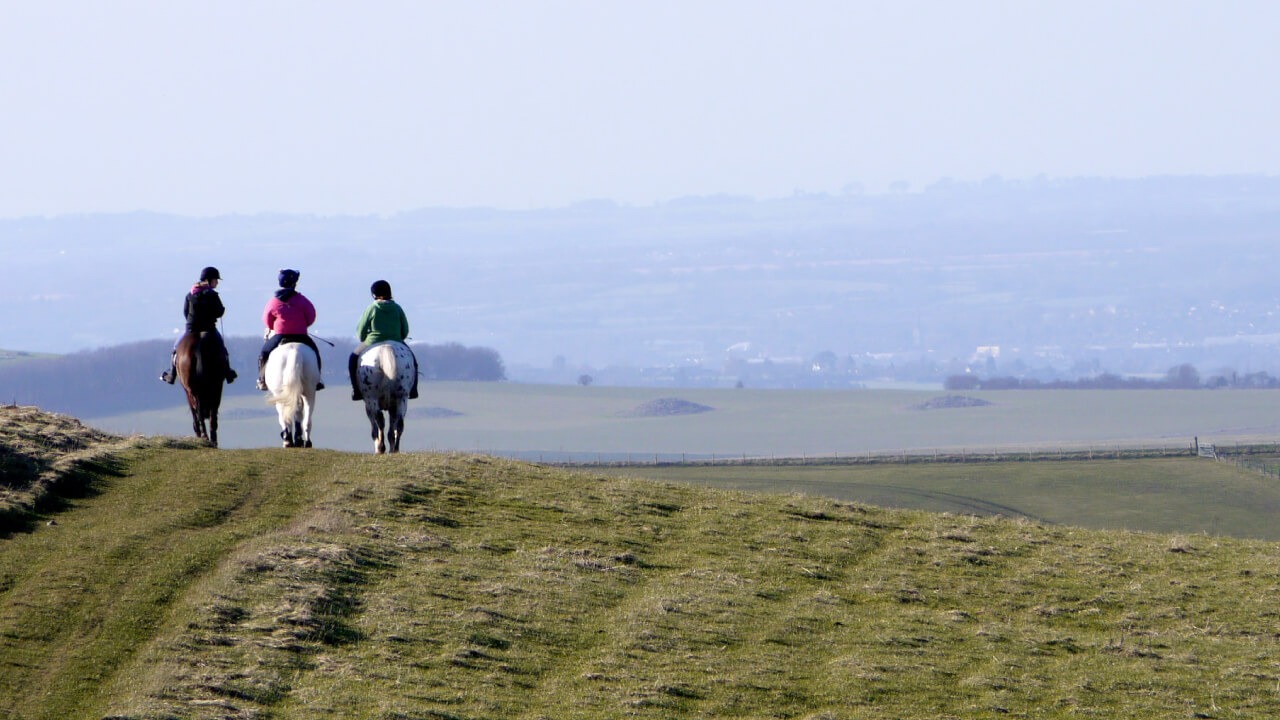
Horses move by walking on all fours, swaying their large bodies. Since they use four legs, their energy consumption seems even more intense than that of bipedal humans.
Furthermore, in period dramas, you often see horses carrying heavy loads traveling long distances over several days alongside humans. So, how far can a horse actually travel in a single day?
Horses have been companions to humans for centuries, thanks to their toughness and utility. Without horses, human history and our daily lives might look very different today.
Differences in Travel Distance Based on Gaits: Types of Gaits and Their Distances

Horses’ gaits are categorized from slowest to fastest as ‘Amble,’ ‘Trot,’ and ‘Canter,’ with a faster gallop called ‘Gallop’ or ‘Full Speed.’
Of course, the slower the gait, the less strain on the horse, allowing for longer distances to be covered.
‘Amble’
The speed is about 110 meters per minute, roughly 6.6 km/h. Since average human walking speed is about 4 km/h, horses are quite faster.
With breaks, a horse can travel about 50-60 km in a day.
‘Trot’
The speed is about 220 meters per minute, roughly 13.2 km/h. This is comparable to jogging for a horse, which can sustain this pace for about an hour.
In a day with several such trots, a horse can cover approximately 30-45 km.
‘Canter’
The speed is about 340 meters per minute, around 20.4 km/h. Continuous cantering is physically demanding, limiting sustained efforts to about 30 minutes.
Maximum daily distance covered is around 30 km.
‘Gallop’
The speed reaches about 1150 meters per minute, approximately 69 km/h. This is a full sprint typical in horse racing.
Due to high energy consumption, sustained galloping lasts only about 5 minutes, covering about 4-5 km at most daily.
Could Horses’ Toughness Have Contributed to Human Civilizations?

In ancient times, horses were originally used as a source of food for humans.
However, humans realized their speed and endurance, leading to horses being used for transportation of goods, human travel, and even communication.
In an era without instant communication or online arrangements, the high physical abilities of horses made them indispensable.
Moreover, sturdy and strong horses contributed significantly to agriculture, helping to develop rough terrains and cultivate vast farmland.
Their work was essential for producing crops and supporting human life, making horses trusted partners that greatly contributed to human civilization.
What is the Endurance Race? Long-Distance Outdoor Riding with Horses

By now, you have seen how tough horses can be and how well they excel at long-distance travel.
Isn’t it fascinating that such capable horses participate in a sport called