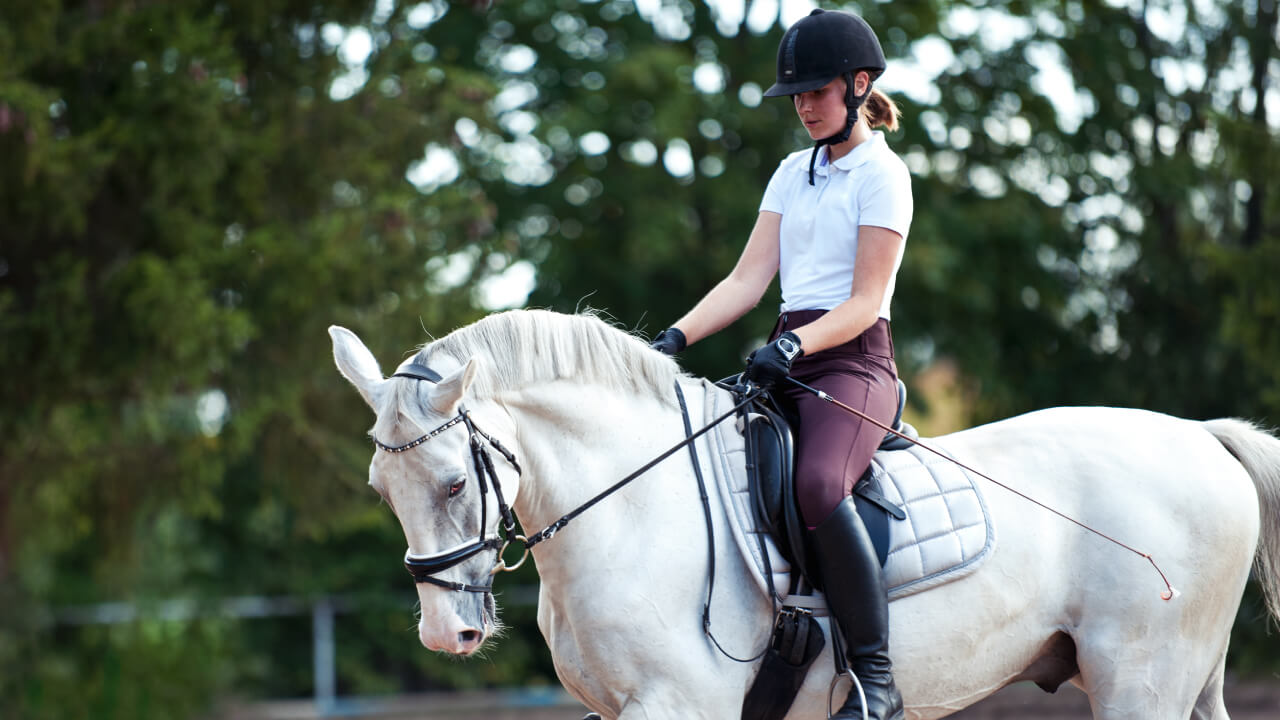
Fairy tales often feature white horses. When we think of the knight in shining armor, the phrase about a white horse is something many women have dreamed of at least once.
White horses frequently appear in movies, but in reality, there seem to be few at riding clubs. How often are white horses born? And are all horses that look white truly white? This article explores these questions and the differences between white horses and albinos.
What is Ashge (Ashge)?

Ashge is one of the coat colors of horses, characterized by white hair. They are not born as white horses immediately.
The base color of their hair is often a mix of chestnut, bay, or blue, with white hair mixed in. Also, their skin is typically black. As they age, the proportion of white hair increases, but some remain with the original color, not turning completely white.
Horses like Oguri Cap and Mejiro McQueen fall into this category. Oguri Cap, who was considered a ‘monster’ for his ash-gray coat, was very dark during his racing days but appeared entirely white at events after retirement.
When a horse is born with very little white hair, it can be difficult to classify it as ashge.
What is Shiroge (White Hair)?

White horses with pure white hair from birth. The key characteristics are, being pure white immediately after birth, and having pink skin. Some might confuse white hair with albinism, but they are different.
White hair is thought to appear due to genetic factors or a sudden mutation, and the precise details are still not fully understood. The chance of a white horse being born is extremely low, estimated at about 1 in 10,000 to 20,000.
The first recorded white horse in Japan was Hakutayu, born in Hokkaido in 1979. Hakutayu’s sire was a black bay, and his dam was black, making his white coat a result of a mutation.
Some famous racehorses with white coats include Yukichan and Sodashi.
What is Samage (Eye-only Gray)?

Samage is a coat color feature where the skin is pink, but the horse’s eyes are blue or gray, making it difficult to distinguish from white horses at first glance. When the base coat color is chestnut, bay, or blue, the entire body appears white. If the original color is bay, the overall body is a reddish-white; if bay, the body is an ivory shade, with some cream tones in the longer hairs.
White horses are rare to born with, especially in Japanese Wazen horses. They are extremely rare.
Distribution of the 8 main coat colors in Thoroughbreds

There are 14 coat colors in horses, including bay, black bay, blue bay, blue, chestnut, bay chestnut, ash gray, white, eye-only gray, riverbed, moon, hoar frost, and mottled. However, in Thoroughbreds, only eight main coat colors are recognized: bay, black bay, blue bay, blue, ash gray, chestnut, bay chestnut, and white. These are officially acknowledged by the Japan Bloodstock Breeders’ Association.
Horse coat colors can be hard to visualize solely by their names. Since we’ve already discussed ashge and white hair, here are descriptions of the other six main colors.
Horse coat colors
‘Bay’ is a reddish-brown body with darker mane and tail, and black legs.
‘Black bay’ is a darker shade of bay, with a reddish-brown body, but it appears nearly black, with slight brownish hues around the nose and eyes.
‘Blue bay’ has a darker shade than black bay, mainly black but with slight brownish areas around the nose and eyes.
‘Blue’ is entirely black, including the long hair.
‘Chestnut’ has a rich brown body with variations from dark to light, including some with almost white hair, but none as black as bay.
‘Bay chestnut’ is a darker chestnut than original chestnut, with some variation in hair color, but no black among these either.
Occurrence rates
In Thoroughbreds, coat colors are not equally common. The most common color is bay, at about 50%, followed by chestnut at 25%, black bay at 14%, ash gray at 7%, with blue bay, bay chestnut, and white being less common. White occurs in approximately 0.04% of cases.
Although horse coat color does not necessarily determine performance in races, a higher commonality means more successful racehorses of that color, and many bay horses have excelled in racing.
Summary
We hope this article has helped you understand that, even among what looks like the same white horses, there are variations—from horses with purely white hair to those with mixed colors, and those that turn whiter with age.
While ‘white horse’ usually refers to white hair, such horses are extremely rare and hard to see. It can sometimes be confusing to distinguish white hair from ashge, and many people unfamiliar with these might mistake ashge or eye-only gray horses for white horses. Many riding clubs and farms list horse profiles; why not try finding these rare white horses? It might become a new and enjoyable hobby.