Hiders and Followers

Are you familiar with the terms ‘hiders’ and ‘followers’? These words describe the maternal behavior of herbivores. The difference is related to their habitat and survival strategies, showing adaptations for staying safe from predators. Let’s explore what each term means.
Hiders
Hiders are animals whose mothers often leave their young hidden in rocks or trees, leaving the offspring to play separately. Mothers tend to stay with their young mainly during feeding. Animals like goats belong to this category, typically inhabiting forests or mountainous areas for hiding.
Followers
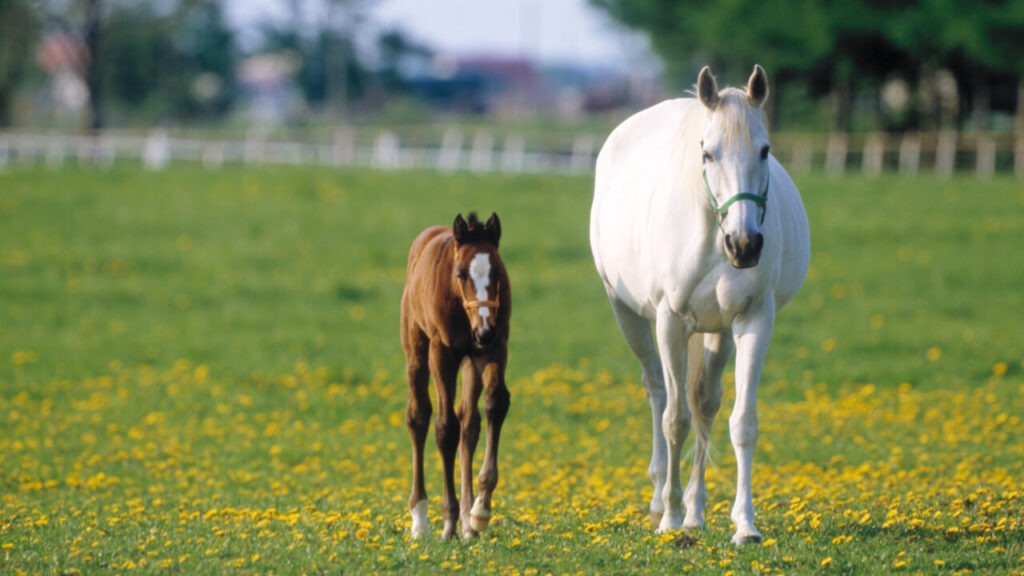
Followers are species where mother and young stay together most of the time, such as horses, sheep, and camels. Have you ever seen a foal tightly attached to its mother on a pasture? These animals usually live in open grasslands, with mothers and herds protecting their young from predators.
Foal Growth
How long do foals stay with their mothers? Let’s look at their development. Equine pregnancy lasts about 11 months, similar to humans, and foals are born typically once per year. Unlike dogs or cats, where multiple offspring are born at once, horses usually give birth to a single foal.
Since herbivores need to escape predators quickly, foals can stand and move shortly after birth. For example, foals can stand within an hour of birth, despite a pregnancy length similar to humans. They stay close to their mother, nursing gradually as they explore their surroundings.
Horse’s Milk Composition

Milk composition varies among species, but all mammal milk contains the necessary nutrients for raising their young.
Milk Components
If we look at horse milk, it has much lower fat content and higher carbohydrate levels compared to milk from dogs, rabbits, pigs, cows, or goats. This composition is similar to human milk.
Nursing Period
The typical weaning period is around six months, during which foals gradually start to eat pasture alongside nursing. Gradually, they transition from nursing to eating grass and hay for their main diet.
Weaning Process
Human infants usually wean by increasing solid foods and reducing breastfeeding gradually. Horses wean around six months, either naturally when the mare ceases producing milk or by separating foals physically. Weaning is a sign of growing independence.
Post-Weaning Concerns
As foals stop nursing, they may experience stress or develop abnormal behaviors like cribbing, which can cause health issues. Proper care and gradual transition are important to prevent complications like weight gain and skeletal stress.
About Nurse Mares

Have you heard of ‘nurse mares’? When a mare that gave birth cannot or refuses to nurse, a surrogate mare takes over to nurse and care for the foal. The choice of surrogate depends on the region and available breeds. Japan often uses calm heavy breeds, while overseas, the process can be more complex, involving scent matching and behavioral training.
Japan
In Japan, gentle heavy breeds are preferred as surrogate mares. They generally produce more milk and have calmer behavior, but differences between heavy and light breeds can affect the foal’s development.
Overseas
Internationally, surrogate mares are usually those whose own foals have died or are unable to nurse, but selecting a suitable surrogate involves techniques like scent matching to help them accept the new foal. Some mares may refuse non-biological foals, but others may develop bonds and nurture them as their own.
Why Humans Don’t Intervene
Rather than human intervention with bottles, it’s often better to let mares and foals develop natural bonds. Human caregiving can cause issues like over-familiarity or social adaptation problems in horses.
Impacts on Surrogate Foals
Though surrogate relationships can be reassuring, they also risk affecting the surrogate mare’s wellbeing, particularly if she’s unable to produce milk or experiences stress when her own foal is removed. Proper care and understanding are essential to support both the surrogate mare and foal.
Summary

Even among herbivores, survival strategies vary by habitat, influencing maternal behaviors and offspring care. When a mare cannot nurse due to death or refusal, humans often provide surrogate mares, but the bonds of natural mothering are profound and irreplaceable. Ensuring the health and happiness of horses depends on attentive care and respect for these natural relationships.